2026 Breakthrough Prize in Fundamental Physics

Steven Giron, Ph.D.

Co-Laureate

Experimental particle physicist. Member of the Muon g−2 Collaboration at Brookhaven National Laboratory, Experiment E821. Director of Education at The New Human University.

g-2μ
The measurement

Dirac said 2.

Paul Dirac's theory says a muon's magnetic strength, its g-factor, should be exactly 2. It isn't. The vacuum around the muon is not empty: virtual particles flicker in and out of existence and nudge g a little above 2. Measure that nudge precisely enough and you are taking a census of everything that exists, including whatever nobody has discovered yet.

So we built a 14-meter superconducting storage ring at Brookhaven, filled it with muons and watched their spins turn slightly faster than their orbits. Twenty-four detector stations around the ring counted the decay electrons. I worked on the electromagnetic calorimeter technology behind those stations. The wobble in their count is the anomaly, aμ.

E821 final result · Phys. Rev. D 73, 072003 (2006)aμ = (g − 2)/2 = 11 659 208.0(6.3) × 10⁻¹⁰

In other words: if you want to know what's really in the room, measure the one thing that is touched by everything in it. Precisely.
Three laboratories

Fifty years, one number.

0.1 ppm1 ppm10 ppmCERN III · 19797.3 ppmBrookhaven E821 · 20060.54 ppmFermilab E989 · 20250.127 ppm

Uncertainty on aμ, log scale. Each generation sharpened the measurement roughly tenfold. The prize honors all three collaborations together.

The pin

A Feynman diagram you can wear.

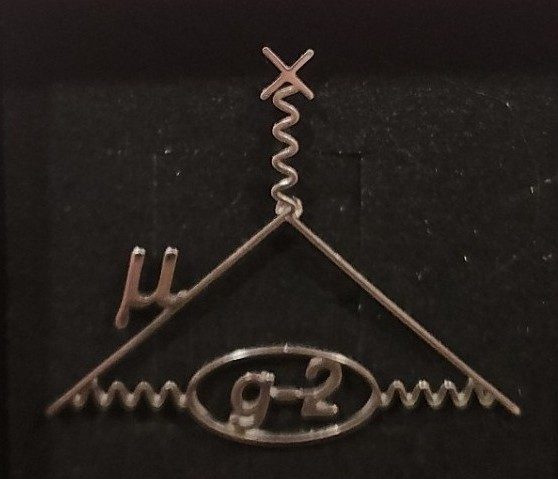
Steel lapel pin shaped like a Feynman diagram: a muon line, a wavy photon ending in an X, and an oval labeled g-2

The collaboration made this pin for the ceremony, and my collaborators wore it on stage. It is the physics in miniature: a muon (μ) meets an external magnetic field (×) through a photon, while the virtual photon in the loop below is dressed by a hadronic blob.

That blob is the hardest piece of the Standard Model prediction to calculate. It is also why the g−2 story kept physicists arguing for two decades.

The roster

Brookhaven co-laureates.

Excerpt, A to J, as listed by the Breakthrough Prize Foundation.

  1. Hyo E. Ahn
  2. John Benante
  3. Eric Benedict
  4. Benjamin Bousquet
  5. Gerry Bunce
  6. Brian Bunker
  7. Robert M. Carey
  8. A. Chertovskikh
  9. Priscilla Cushman
  10. Paul Debevec
  11. Mario Deile
  12. Huaizhang Deng
  13. William Deninger
  14. Satish K. Dhawan
  15. Vladimir P. Druzhinin
  16. Long Duong
  17. William Earle
  18. Efstratios Efstathiadis
  19. Kuninori Endo
  20. Gennady V. Fedotovich
  21. Xiang Fei
  22. Joe Geller
  23. Johannes Gerhaeuser
  24. Steven Giron
  25. Vladimir B. Golubev
  26. Frederick E. Gray
  27. Michael A. Green
  28. Dmitry N. Grigorev
  29. Matthias Grosse-Perdekamp
  30. Alex Grossmann
  31. Ulrich Haeberlen
  32. Matthew F. Hare
  33. Eric Hazen
  34. David W. Hertzog
  35. Dick Hseuh
  36. Xiaobo Huang
  37. Masaharu Iwasaki
  38. John W. Jackson
  39. Lin Jia
  40. Timothy D. Jones

Full list of CERN, Brookhaven and Fermilab co-laureates at breakthroughprize.org.

The ceremony

18 April 2026.

$3Mshared across three collaborations
Santa MonicaBarker Hangar, black tie
Altman & Cheskypresented the physics prize

David Hertzog accepted on behalf of the collaborations. The citation reads: “For multi-decade, groundbreaking contributions to the measurement of the muon’s anomalous magnetic moment.”

Trailer

Thirty-six seconds of g−2.

Mockup cut with a synthesized score: a low drone, and a pulse each time the muon passes one of the 24 stations. The pulse pans around the ring and swells with the g−2 wiggle. Voice-over is the next pass.